Finite Element Method for Plasmonics
Publications : [1-4], [11-13], [16].
Funding : NSF DMS-2009366 ($295k, single PI, 2020-2024)
Modeling Plasmonic Phenomena
Plasmonic structures are made of a positive material (dielectrics) and a negative material (metals at optical frequencies, metamaterials). Surface electromagnetic waves called surface plasmons can appear at the interface.
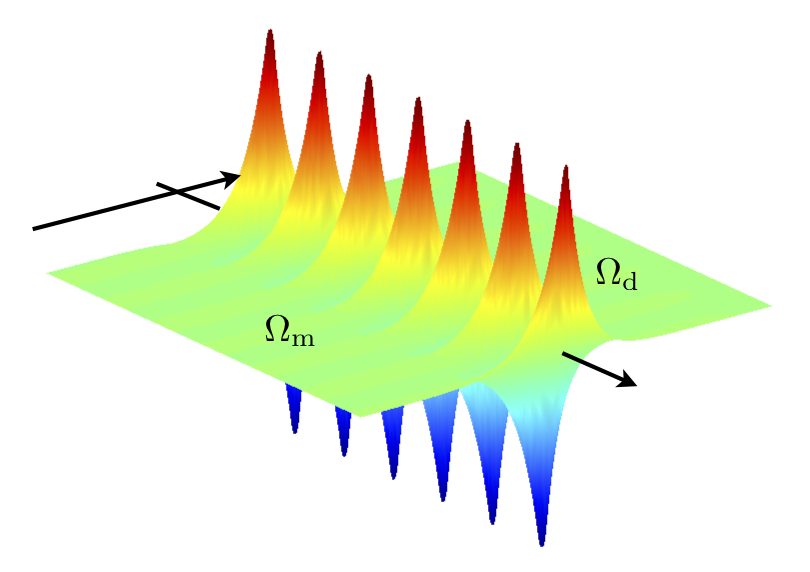
Guiding and confining such particular waves in nanophotonic devices reveal a great interest to overcome the diffraction limit, in nanophotonic sensing and related applications.
Due to potential sign-changing coefficients, standard methods fail to capture plasmonic phenomena. We propose several technique to address this problem.
Challenges
- Multiple scales
- Surface plasmons are very sensitive to the geometry (corners)
- Inaccurate predictions of the near-field
- Hyper-oscillating singularities, called black-hole waves, appear at the corners
- Standard FEM fail due to spurious reflections
Novel Numerical Methods using FEM
Mesh requirements to ensure FEM optimal convergence via the T-coercivity
with A.-S. Bonnet Ben Dhia, P. Ciarlet, Z. Moitier
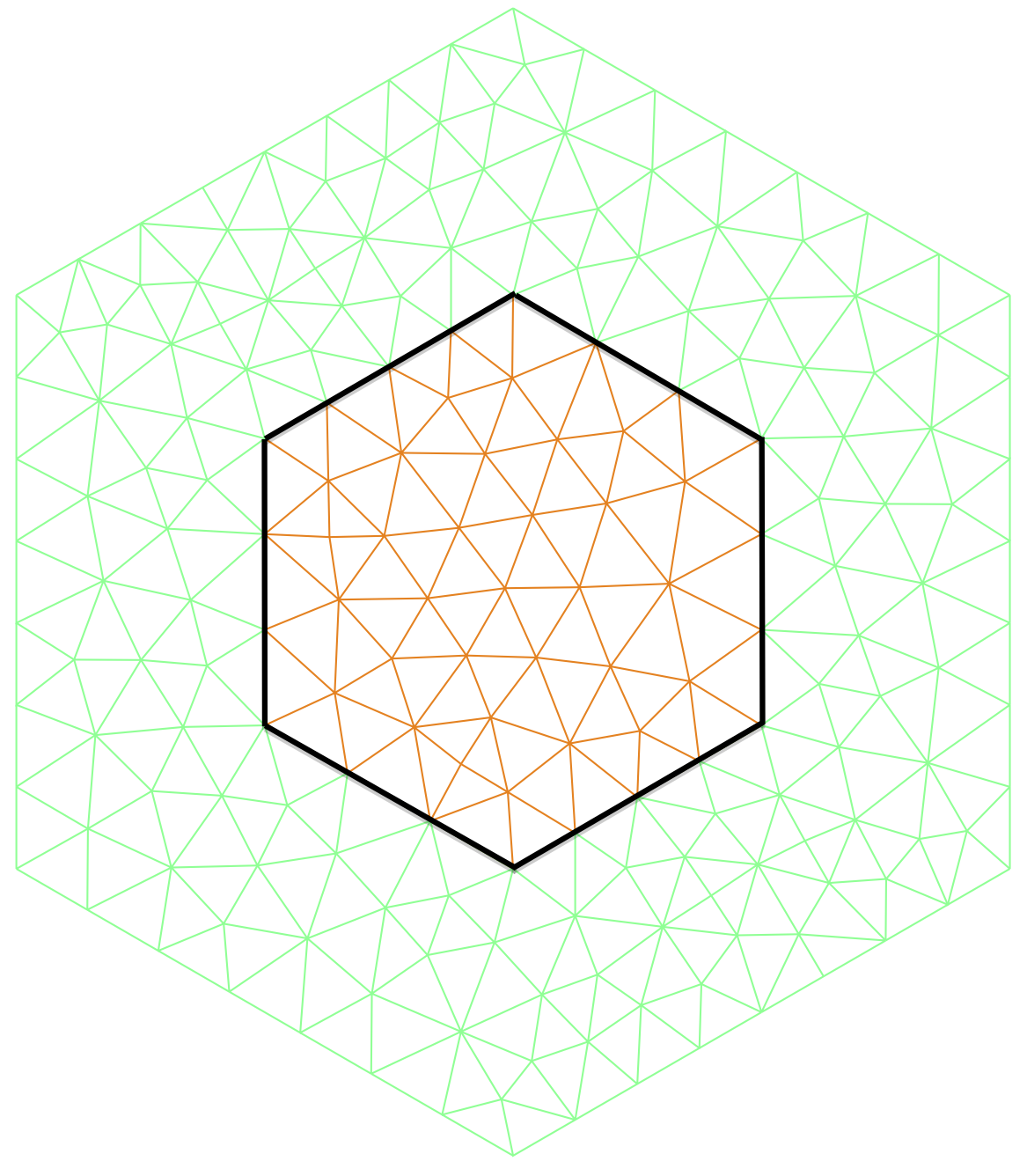
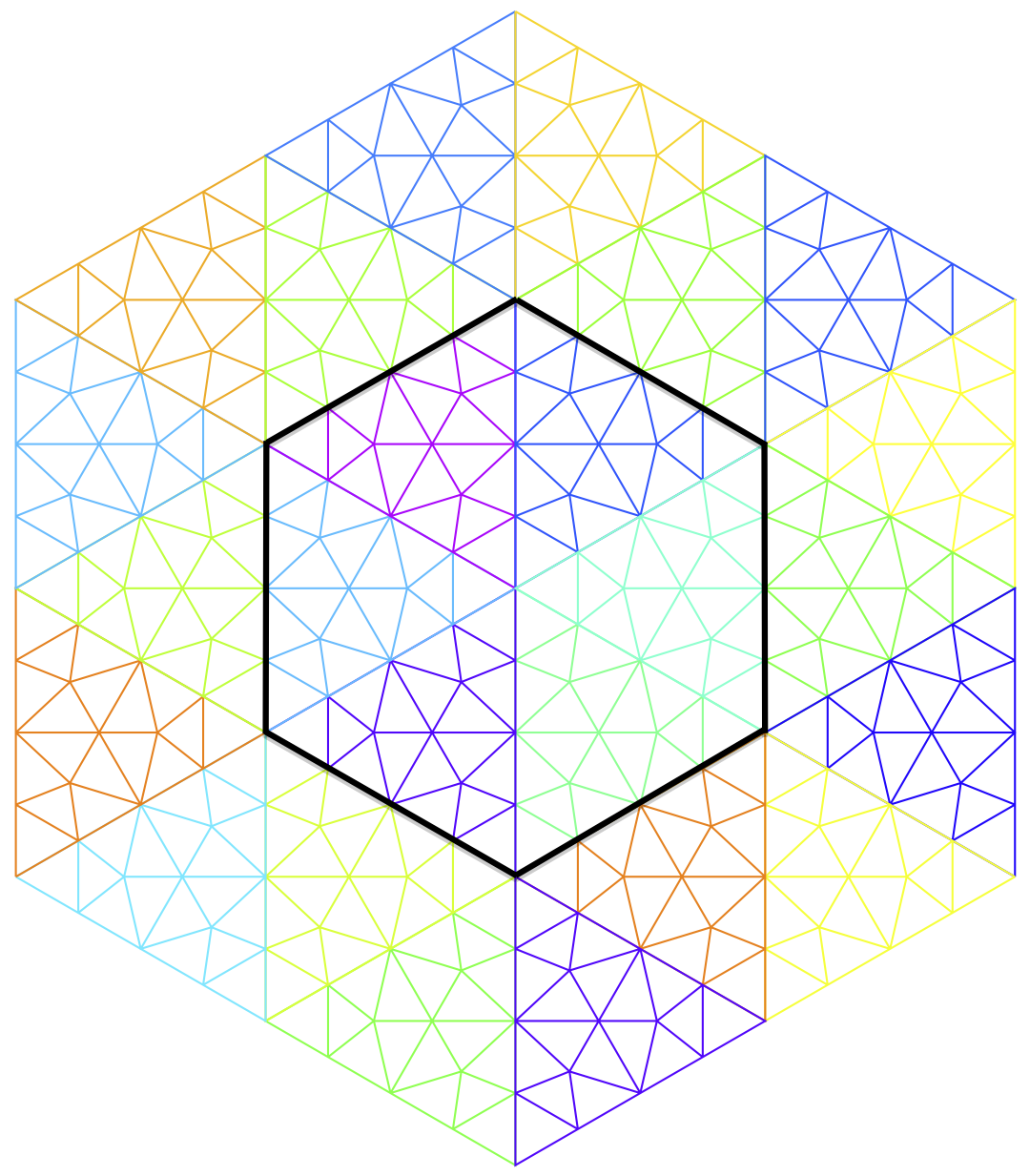
Well-posedness of transmission problems with sign-changing coefficients has been established using the so-called T-coercivity theory. However, in practice it is not as straightforward to apply it. We designed "FEM friendly" T operators to guarantee optimal FEM convergence. Those operators are based on rotations and symmetries, they ensure same well-posedness and are easily satisfied at the discrete level by designing locally symmetric meshes. A package providing automatic locally T-conforming mesh is under construction.
Use of Perfectly Matched Layers at the corners to capture the black-hole waves
with A.-S. Bonnet Ben Dhia, L. Chesnel, P. Ciarlet
The T-coercivity theory allows to establish well-posedness and FEM convergence under some conditions on the optical parameters of the scatterer. In the critical regime, where the problem is ill-posed, highly oscillatory singularities (called black-hole waves) appear at the corners. We proposed to use Perfectly Matched Layers at the corners to capture them. This approach is motivated by a quasi-static approximation and a change of coordinates, allowing to interpret the singularities as propagative modes in a waveguide.

Asymptotic characterization of plasmonic scattering resonances and Trefftz methods
with B. Latham, Z. Moitier
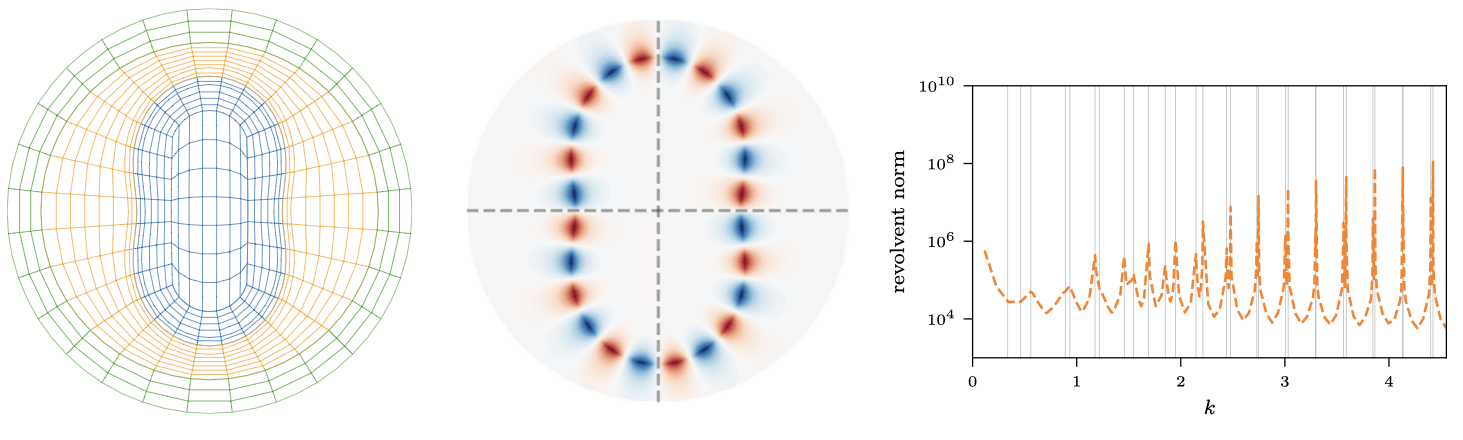
While the T-coercivity can guarantee well-posedness of the scattering problems in plasmonic structures, in practice FEM exhibits numerical instabilities at specific wavenumber inputs. Those values are close to so-called scattering resonances. In general, it is impossible to have the exact scattering resonances. Using the Black-Box Scattering Theory and the quasi-modes analysis, we estalished their existence and provided an asymptotic characterization.
While FEM fails to capture them due to their high amplitude signal, we investigated a Trefftz approach (called Evanescent Plane Wave Discontinuous Galerkin) to better mimic their local behavior. Well-posedness of the associated discrete problem has been established, and gets rid of the high mesh constrains imposed by T-coercivity.